My poor ewes. Every spring, since I brought my first sheep home, our fuzzy friends have always had a bit of a cough and nasal discharge. It's never been bad; it's always cleared up on it's own, but it also always seemed to pop up again when it would be particularly rainy. After talking to several other shepherds and shepherdesses, and a couple of vets, I settled on "mysterious allergies" and tried to stop cringing when I heard the all-too-humanlike hack come from the field.
Well, a couple of weeks ago my sheep were acting very strange. They would shove their noses to the ground and run around in jerky motions, often sticking their faces in the grass or in corners of shade. They were also twitching constantly, and tripping when they ran. I treated them for grass tetany because I know we've had magnesium issues in the past, and in the process of rounding them up and dosing them they all improved (pretty much immediately, which I thought was weird.)
Then, last night while I was out putting up the ducks and chickens, I noticed they were doing it again!
This was very weird because just yesterday morning I hand sheared one of my ewes (her condition is awesome, by the way!) and when I finished, I dosed her with extra vitamins and minerals, as well as some magnesium. If she'd gotten magnesium in the morning, she shouldn't have been showing signs of magnesium deficiency only 12 hours later. I started some fierce googling and finally found this:
This is a video another shepherdess has posted of her sick sheep, and it shows the exact behavior that my sheep have been exhibiting. It's creepy behavior, too!
One of the comments below suggests nose bots, so I started reading up on them and sure enough the symptoms fit precisely, right down to the slight nasal discharge.
The two days that the sheep have shown the most distress have been the hottest most fly-filled days. My poor ladies...
Last night I dug around until I actually managed to find my bottle of ivermectin and a spare sheep drenching gun (like a super heavy duty needle-less syringe that we use to give them liquid meds/vitamins) and armed with my handy-dandy headlamp (aka face-bug-target) I headed out to the barn and drenched them all with ivermectin, as well as vitamins A, D, B and E, selenium and magnesium just for the helluvit. They actually all drenched fairly easily; I usually have to bring Jeremy along to be the muscle, but I've been shoveling treats down their throats in an effort to make bringing them off the grass an easier task, and apparently this has paid off and they all "like" me now... Haha. Bribery will get you EVERYWHERE in the livestock world!
Anyway, I'll keep an eye on them, but this should at least take care of the current nose bot issues. I'll have to come up with some sort of repellent or something for them for the rest of the year though, or else I'll have to keep worming them which I really hate to do. I had been so proud, too, because I'd been chemical-free for so many months with no parasite issues... damn.
Showing posts with label problems. Show all posts
Showing posts with label problems. Show all posts
Tuesday, May 21, 2013


Sunday, January 22, 2012
Hero's First Arena Turn Out
Today was the day I'd both been looking forward to and dreading; This was the day I had planned to let Hero loose in the indoor riding arena to really see her progress.
It's a scary thing to do because since her ligament injury she has had very little change to walk around, let alone run. Horses with a lot of energy can do stupid things, injuring themselves with a wrong turn or twist, and if she re-injures that ligament she's toast... I'd hate to retire her at seven years old!
So here is the video of her strutting her stuff in the indoor. She only bolted a few times up and down the long side of the arena, and each time she did some fancy turns and stops that made my stomach do flips, but she didn't re-injure herself and she managed to wear herself out after a few short minutes.
What a good day!
Thursday, January 19, 2012
Hero's Day Out
Yesterday was a good day, despite some difficult twists and turns. The biggest highlight of my day, and probably my week, was that I got to sit on the back of my horse, Hero, who is recovering from a bad ligament strain (possibly even a tear; we're not sure.)
This Sunday will mark the tenth consecutive week that Hero has spent in a box stall. She originally had an abscessed hoof, and unfortunately the ligament injury was compensatory for that. Poor Hero. The first week or two was really rough. She wouldn't stand on her abscessed hoof and she couldn't stand on her injured leg, so she literally spent more than a week standing on two legs, only setting the tips of her toes down to balance occasionally. She already has leg issues, as she as malnourished as a foal, and her front legs are two different lengths, her right foot being somewhat clubby. The vet, and my own trainer whom I really look up to, told me that she'd be a good school horse but she'd probably never excel at anything. Before her injury, however, she was working on second level movements in dressage including half pass and she was really starting to collect, and she had jumped 3'9" with beautiful form and ease... psh... That's excelling in my book!
I kept a pressure wrap on her leg for more than eight weeks straight, changing it several times a week and dealing with poor Hero's irritated antics (kicking, biting, shoving, head waggling..) because the poor thing is so bored in that stall. She is used to being turned out 24/7, and she took her playing in the field very seriously before this. For the first month, I kept her in her stall in the middle of the barn and she was outright MEAN to anybody or any horse that came by. She would lunge through the opening by the grain bin and try to bite, she would spin and kick if you came into the stall... it was scary. She has been one of the most sweet, albeit expressive horses I've ever known, and this is where she started to make her opinion very clear.
After a month or so I moved her to the very last stall in the barn so that she could see her friends in the field and so they could stick their heads over the gate to visit when they come up for water. There was an instant change in Hero. She became friendly again and stopped some of the neurotic behaviour she'd had before I moved her.
So, flash forward to this week: Hero's pressure wrap has been off for more than a week now and she has been working in hand at both the walk and trot soundly. At one point the other day I went to introduce her to a new friend that she'd be recovering with in the small paddock eventually. When she saw him, she pulled free from me and bolted around the muddy paddock for five minutes, galloping, twisting, spinning and kicking up... all the while this was happening I kept having flashes of her leg, ballooned up, and myself signing her over to a retirement home. Blech. I finally caught her, thanks to a fantastic student who ran out with a bucket of grain, and shoved her in a stall for a few hours while I taught, trying not to think about what she'd just done to her leg.
When I came back to her after teaching, her leg was fine, and she was asking for more! So I gave her a few more days of relaxed hand walking and trotting and then I came to yesterday when I decided I would finally sit on her again.

She has been antsy and slightly unpredictable, since she's such a bored horse, but as my butt sat on her back she immediately put on her game face and went to work. It was amazing! She obviously remembers that working in the arena is her job and it doesn't matter if she's been cooped up for months, if she's doing her job, she does it right. What a fantastic work ethic! I rode her for almost ten minutes, just walking her in large figures while asking her to soften and stretch down so her back muscles would get a good work out. It was fantastic.
I'm hoping this is the start to her coming back into real work. For now I'll be hand walking her 3-4 times a week and riding her bareback another 2-3 times a week. Hopefully after she builds some muscle she'll be ready to go back to work! Before her injury, Hero was a fantastic dressage horse and a very promising jumper. When she was jumping 3'-3'9" with me it was with very little effort, but she really never had the forward drive of a competitive jumper. I always assumed it would come with time, but maybe this is a sign that she shouldn't jump. My plan for now is to keep babying her until the end of February, when I'll make the decision to keep her on as a school horse or to sell her to someone who will use her more lightly to prevent further injury, something I don't particularly want to think about.
Still, that's a decision for down the road. Yesterday was a huge triumph for both of us, and I'm so happy to see that she's ready and willing to go back to work. Horses are really amazing creatures...
This Sunday will mark the tenth consecutive week that Hero has spent in a box stall. She originally had an abscessed hoof, and unfortunately the ligament injury was compensatory for that. Poor Hero. The first week or two was really rough. She wouldn't stand on her abscessed hoof and she couldn't stand on her injured leg, so she literally spent more than a week standing on two legs, only setting the tips of her toes down to balance occasionally. She already has leg issues, as she as malnourished as a foal, and her front legs are two different lengths, her right foot being somewhat clubby. The vet, and my own trainer whom I really look up to, told me that she'd be a good school horse but she'd probably never excel at anything. Before her injury, however, she was working on second level movements in dressage including half pass and she was really starting to collect, and she had jumped 3'9" with beautiful form and ease... psh... That's excelling in my book!
I kept a pressure wrap on her leg for more than eight weeks straight, changing it several times a week and dealing with poor Hero's irritated antics (kicking, biting, shoving, head waggling..) because the poor thing is so bored in that stall. She is used to being turned out 24/7, and she took her playing in the field very seriously before this. For the first month, I kept her in her stall in the middle of the barn and she was outright MEAN to anybody or any horse that came by. She would lunge through the opening by the grain bin and try to bite, she would spin and kick if you came into the stall... it was scary. She has been one of the most sweet, albeit expressive horses I've ever known, and this is where she started to make her opinion very clear.
After a month or so I moved her to the very last stall in the barn so that she could see her friends in the field and so they could stick their heads over the gate to visit when they come up for water. There was an instant change in Hero. She became friendly again and stopped some of the neurotic behaviour she'd had before I moved her.
So, flash forward to this week: Hero's pressure wrap has been off for more than a week now and she has been working in hand at both the walk and trot soundly. At one point the other day I went to introduce her to a new friend that she'd be recovering with in the small paddock eventually. When she saw him, she pulled free from me and bolted around the muddy paddock for five minutes, galloping, twisting, spinning and kicking up... all the while this was happening I kept having flashes of her leg, ballooned up, and myself signing her over to a retirement home. Blech. I finally caught her, thanks to a fantastic student who ran out with a bucket of grain, and shoved her in a stall for a few hours while I taught, trying not to think about what she'd just done to her leg.
When I came back to her after teaching, her leg was fine, and she was asking for more! So I gave her a few more days of relaxed hand walking and trotting and then I came to yesterday when I decided I would finally sit on her again.

She has been antsy and slightly unpredictable, since she's such a bored horse, but as my butt sat on her back she immediately put on her game face and went to work. It was amazing! She obviously remembers that working in the arena is her job and it doesn't matter if she's been cooped up for months, if she's doing her job, she does it right. What a fantastic work ethic! I rode her for almost ten minutes, just walking her in large figures while asking her to soften and stretch down so her back muscles would get a good work out. It was fantastic.
I'm hoping this is the start to her coming back into real work. For now I'll be hand walking her 3-4 times a week and riding her bareback another 2-3 times a week. Hopefully after she builds some muscle she'll be ready to go back to work! Before her injury, Hero was a fantastic dressage horse and a very promising jumper. When she was jumping 3'-3'9" with me it was with very little effort, but she really never had the forward drive of a competitive jumper. I always assumed it would come with time, but maybe this is a sign that she shouldn't jump. My plan for now is to keep babying her until the end of February, when I'll make the decision to keep her on as a school horse or to sell her to someone who will use her more lightly to prevent further injury, something I don't particularly want to think about.
Still, that's a decision for down the road. Yesterday was a huge triumph for both of us, and I'm so happy to see that she's ready and willing to go back to work. Horses are really amazing creatures...
Tuesday, September 27, 2011
Woolies and their Woes (part one: A Farewell)
I'm not sure how many readers follow my social networking accounts as well, but I'm sure some of you have heard that poor Gertrude didn't make it this past week.
On Wednesday of last week I got up extra early to check on Gert. When I found her she was lying down, panting and grinding her teeth as if in pain. I knew it was time. The sparkle was gone from her eye and she looked at me with a very sad and calm expression that I hoped I would never see on such a spunky creature. I knelt beside her and scratched her cheek, and while she took some comfort from it, it was obviously through the kind of thick haze of lethargy that clouds someone on death's door. I tried to get her to stand, to nibble some alfalfa, to sniff a dandelion (which had been the only thing she would eat with appetite the day before)... she was only interested in letting the inevitable run it's course. I tried giving her a final dose of Banamine to ease whatever pain she was in and quickly found that she didn't even have the strength to swallow. The paste sat on her tongue where I knew it would do at least a little bit of good as it absorbed through her mouth.
As I walked to the house I dialed the vet and scheduled him to come out to the farm to help her on her way. Gertrude was definitely a pet sheep and as such she deserved to go quickly and quietly with the aid of the "big pink syringe".
I trudged up the stairs to our bedroom and flopped down beside Jeremy, who was still dozing, and told him that she wasn't going to make it. It was a sad realization, but it wasn't surprising to me. This poor ewe had been battling illness for more than eight weeks. I rolled over on the bed and propped myself up on my elbows so I could see her from the window.
After a minute I saw her shudder and her back legs spasm and I sprang from the bed. I don't even remember traveling from the house to the field. I can't even tell you if I used the gate or hopped the fence. Before I knew what was happening, I was kneeling beside her again, just as she gave a deep sigh and was gone. It was hard to watch the residual electrical impulses from her brain wrack her body after that. I knew she was gone. Her heart had stopped, as had her breathing, and her pupils had relaxed, but each time she twitched there was this unreasonable hope in my heart that she had decided to continue her fight. As her body finally settled I realized that more than anything, I was left intensely inspired by her determination to keep going as long as she did. Eight grueling weeks spent battling mysterious illness and bizarre symptoms, fighting what we're nearly sure was a genetic predisposition to white muscle disease as the damage to her heart and diaphragm slowly weakened her - She could be a poster child for the Icelandic sheep: Strong, Independent, Persistent and ultimately Stubborn.
 We left her body in the field to try to keep Brighid as calm as possible while we made preparations to pick up a new companion for her. It's funny how, despite being incredibly sad, one's brain can make the smooth transition from one crisis to another. Brighid was going to realize sooner or later that she was alone and it wasn't going to be pretty. She spent the early afternoon snuggled up with some chickens near Gertrude's body. It was such a sad thing to see. Poor Brighid had already lost her mother earlier this year to grass tetany, and now she had lost her best friend.
Finally we removed Gertrude's body and buried her beside Ingrid's at a friend's house down the road. Of course the spot we picked to dig was clay and rocks which we had to chuckle about; nothing with Gertrude was ever easy.
We put away the poultry for the night and got in the station wagon, bound for Olivet to pick up a new companion (or two) for Brighid...

 |
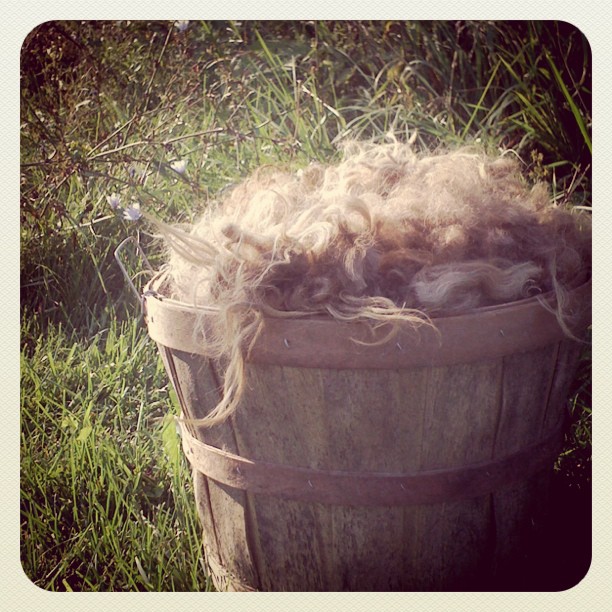
| Gertrude, her first week with us. |
As I walked to the house I dialed the vet and scheduled him to come out to the farm to help her on her way. Gertrude was definitely a pet sheep and as such she deserved to go quickly and quietly with the aid of the "big pink syringe".
I trudged up the stairs to our bedroom and flopped down beside Jeremy, who was still dozing, and told him that she wasn't going to make it. It was a sad realization, but it wasn't surprising to me. This poor ewe had been battling illness for more than eight weeks. I rolled over on the bed and propped myself up on my elbows so I could see her from the window.
After a minute I saw her shudder and her back legs spasm and I sprang from the bed. I don't even remember traveling from the house to the field. I can't even tell you if I used the gate or hopped the fence. Before I knew what was happening, I was kneeling beside her again, just as she gave a deep sigh and was gone. It was hard to watch the residual electrical impulses from her brain wrack her body after that. I knew she was gone. Her heart had stopped, as had her breathing, and her pupils had relaxed, but each time she twitched there was this unreasonable hope in my heart that she had decided to continue her fight. As her body finally settled I realized that more than anything, I was left intensely inspired by her determination to keep going as long as she did. Eight grueling weeks spent battling mysterious illness and bizarre symptoms, fighting what we're nearly sure was a genetic predisposition to white muscle disease as the damage to her heart and diaphragm slowly weakened her - She could be a poster child for the Icelandic sheep: Strong, Independent, Persistent and ultimately Stubborn.
 We left her body in the field to try to keep Brighid as calm as possible while we made preparations to pick up a new companion for her. It's funny how, despite being incredibly sad, one's brain can make the smooth transition from one crisis to another. Brighid was going to realize sooner or later that she was alone and it wasn't going to be pretty. She spent the early afternoon snuggled up with some chickens near Gertrude's body. It was such a sad thing to see. Poor Brighid had already lost her mother earlier this year to grass tetany, and now she had lost her best friend.
Finally we removed Gertrude's body and buried her beside Ingrid's at a friend's house down the road. Of course the spot we picked to dig was clay and rocks which we had to chuckle about; nothing with Gertrude was ever easy.
We put away the poultry for the night and got in the station wagon, bound for Olivet to pick up a new companion (or two) for Brighid...

Monday, September 19, 2011
Gertrude
My dear sweet Gertrude appears to be in a slow and bumping downward spiral. I think that I have finally figured out what it is that has been causing all of her symptoms. It was staring me in the face the whole time.
White Muscle Disease.
The white muscle disease can affect any skeletal or cardiac muscles, and in severe cases can cause damage in the heart and diaphragm. The symptoms of these complications?

We do have a day here and there where she appears to be 100%. Her edema will clear up, she'll head out to the back pasture to graze and glean windfall apples, and her bleat will sound normal. This doesn't seem to last for more than a day or two. Three at most. And then she deteriorates again... swollen face, not bothering to go out for grass, etc. She has been eating, which is what has kept my hope up, but yesterday there was a change.
I had run out of their previous grain and was switching them to a new bag - the same stuff they'd been eating, but a different batch. When I poured their grain into their feed pans, the two sheep came running - Gertrude even managed a lumbering gait, herself. They stuck their snuffley faces into the pan and immediately Gertrude pulled her face back out. She is just disinterested. It's almost like she was expecting something else and was disappointed. Brighid was confused by Gert's lack of enthusiasm and munched less enthusiastically (I think she likes the tussle for grain).
This morning, even stranger, she was that way for her hay, too. If I throw her some new hay she gets super excited, lumbers over and shoves her face into the green leaves. Within a few seconds though she pulls her head back out and appears to lose interest. I had thought that maybe she had lost interest because she had been stung by a bee while foraging for apples, but it seems like after almost 24 hours she should be comfortable enough to eat again.
I'm kind of stumped for now. As in many cases with failing livestock, it's become a waiting game. I have been out in the barn every few hours to cheer her on as she eats a bit. If I hand feed her the grain or the hay she seems to have renewed interest. She'll munch from my hand for a minute or two and then trundle over to the hay bin and eat there for a minute or two on her own before lying down again. All I can hope is that when I leave the barn each time she continues to eat on and off, and it's not just with my encouragement that she takes food. Through all of this, she has always had appetite. This change makes me think we may be nearing the end...
If she gets much worse, I will have the vet out to help her along on her way. My hesitation is not only that she still has a glint of determination in her eye, but that she is the only companion for my other sheep, Brighid. Brighid lost her mother earlier this year - I don't know how she would take losing her only other companion. I do intend to get at least one other sheep, but I was hoping to wait until November to do that.
So yes. Waiting to see whether the downward spiral continues, or whether Gertrude can get herself turned around... I'll keep you all posted.
White Muscle Disease.
The white muscle disease can affect any skeletal or cardiac muscles, and in severe cases can cause damage in the heart and diaphragm. The symptoms of these complications?
- Persistent Fever
- Edema (presenting at first like bottlejaw)
- Irregular and raised respiratory and heart rates
- "Grunty" sound in the throat when breathing/eating (likely due to edema)
(This also showed up in Gert as "mumblebaas" as my brother put it. Mumbled bleating) - Frothy white or clear nasal discharge
- Stiffness of gait

We do have a day here and there where she appears to be 100%. Her edema will clear up, she'll head out to the back pasture to graze and glean windfall apples, and her bleat will sound normal. This doesn't seem to last for more than a day or two. Three at most. And then she deteriorates again... swollen face, not bothering to go out for grass, etc. She has been eating, which is what has kept my hope up, but yesterday there was a change.
I had run out of their previous grain and was switching them to a new bag - the same stuff they'd been eating, but a different batch. When I poured their grain into their feed pans, the two sheep came running - Gertrude even managed a lumbering gait, herself. They stuck their snuffley faces into the pan and immediately Gertrude pulled her face back out. She is just disinterested. It's almost like she was expecting something else and was disappointed. Brighid was confused by Gert's lack of enthusiasm and munched less enthusiastically (I think she likes the tussle for grain).
This morning, even stranger, she was that way for her hay, too. If I throw her some new hay she gets super excited, lumbers over and shoves her face into the green leaves. Within a few seconds though she pulls her head back out and appears to lose interest. I had thought that maybe she had lost interest because she had been stung by a bee while foraging for apples, but it seems like after almost 24 hours she should be comfortable enough to eat again.
I'm kind of stumped for now. As in many cases with failing livestock, it's become a waiting game. I have been out in the barn every few hours to cheer her on as she eats a bit. If I hand feed her the grain or the hay she seems to have renewed interest. She'll munch from my hand for a minute or two and then trundle over to the hay bin and eat there for a minute or two on her own before lying down again. All I can hope is that when I leave the barn each time she continues to eat on and off, and it's not just with my encouragement that she takes food. Through all of this, she has always had appetite. This change makes me think we may be nearing the end...
If she gets much worse, I will have the vet out to help her along on her way. My hesitation is not only that she still has a glint of determination in her eye, but that she is the only companion for my other sheep, Brighid. Brighid lost her mother earlier this year - I don't know how she would take losing her only other companion. I do intend to get at least one other sheep, but I was hoping to wait until November to do that.
So yes. Waiting to see whether the downward spiral continues, or whether Gertrude can get herself turned around... I'll keep you all posted.
Saturday, August 6, 2011
Sheep and The Stresses of Summer
Sheep.
I had to choose sheep as my first venture into livestock. Of course then we're hit with the hottest summer we've had in years and I, a lowly newb of a shepherdess, am so over my head it's not even funny.
In case you haven't heard, Gertrude is not doing well. She had what we believed to be white muscle disease and over the past ten days had made a fantastic recovery. Then yesterday morning I went out to find her with the very beginnings of bottlejaw, which is a sign of severe anemia. The strange thing is I had just wormed her, and I'd been treating her with all sorts of supplements and vitamins. The bottlejaw showed up much faster than I'd ever heard of, materializing into a massive lump within just hours. By the afternoon heat, Gertrude was lying flat, still in good spirits, but very, very lethargic. The evening showed a bit of improvement, as she was up again, and walking around the field.
Then this morning she was flat again, this time in the cool morning air. Her ears were lower than usual, and her eyelids, in a sort of drunken lethargic stare. I gave her a bit of vitamin B and started the phone calls. There are so many vets in this area that don't treat sheep it's ridiculous! I finally found one who would be able to see her, but their mobile unit was in the shop for the day so they asked me to bring her in. Yeesh. Have I mentioned I love my station wagon?

We brought them into the vet and within a few minutes the doctor seemed a bit stumped. When he heard that she had a miscarriage earlier this year he began to suspect perhaps Gertrude had only miscarried one of twins and that she might have a mummified fetus internally.

Basically we're giving her antibiotics and anti-inflammatories in the hopes of getting her through the hot weekend. She did have a fairly high parasite load of worms that are not covered by the Levasol and Safegard that I had given her, so we treated both little ladies with IM Ivermectin. I can only hope that those treatments, combined with increasing her vitamins B and E, her protein, her trace minerals, her selenium and her grain we can get ahead of whatever it is that she is suffering from. What a day.
I had to choose sheep as my first venture into livestock. Of course then we're hit with the hottest summer we've had in years and I, a lowly newb of a shepherdess, am so over my head it's not even funny.
In case you haven't heard, Gertrude is not doing well. She had what we believed to be white muscle disease and over the past ten days had made a fantastic recovery. Then yesterday morning I went out to find her with the very beginnings of bottlejaw, which is a sign of severe anemia. The strange thing is I had just wormed her, and I'd been treating her with all sorts of supplements and vitamins. The bottlejaw showed up much faster than I'd ever heard of, materializing into a massive lump within just hours. By the afternoon heat, Gertrude was lying flat, still in good spirits, but very, very lethargic. The evening showed a bit of improvement, as she was up again, and walking around the field.
Then this morning she was flat again, this time in the cool morning air. Her ears were lower than usual, and her eyelids, in a sort of drunken lethargic stare. I gave her a bit of vitamin B and started the phone calls. There are so many vets in this area that don't treat sheep it's ridiculous! I finally found one who would be able to see her, but their mobile unit was in the shop for the day so they asked me to bring her in. Yeesh. Have I mentioned I love my station wagon?

We brought them into the vet and within a few minutes the doctor seemed a bit stumped. When he heard that she had a miscarriage earlier this year he began to suspect perhaps Gertrude had only miscarried one of twins and that she might have a mummified fetus internally.

Out came the ultrasound and after an interesting struggle, all the while with Brighid trying to stand on top of Gertrude to protect her, we were able to see that Gertrude has a massive amount of fluid in her abdomen, which is connected to the bottlejaw. What the vet unfortunately could not see was anything indicative of a mummified fetus. Of course this didn't rule out the possibility. As with all ultrasounds, it just meant there just wasn't a mummified fetus on the screen.
Basically we're giving her antibiotics and anti-inflammatories in the hopes of getting her through the hot weekend. She did have a fairly high parasite load of worms that are not covered by the Levasol and Safegard that I had given her, so we treated both little ladies with IM Ivermectin. I can only hope that those treatments, combined with increasing her vitamins B and E, her protein, her trace minerals, her selenium and her grain we can get ahead of whatever it is that she is suffering from. What a day.
So if you'll excuse me, I intend to finish the rest of my grouchy, grumbley day in my pajamas, on the couch, watching Dr. Who on DVD... eating junk food.
Sunday, July 17, 2011
The Cutest little Menace
*Siiiiiiigh*
 We have had our defenses breached by a sly, devious menace. He slips in and out leaving no trace of his presence but the thick destruction of poultry. Mr Mink is a bastard. He first killed on Thursday night, making quick work of every single quail in the pen. He killed every bird, then lined them up and proceeded to decapitate one of them. Was he sending me a warning?
I couldn't help but think GEEZ what a jerk.
So I've been diligently trying to trap the little assassin for the past few nights. Last night he struck again, taking two buckeye chicks. He had the audacity to drag one off, right in front of my face!
I'm pretty irritated about the whole thing. I could handle a raccoon, or a opossum, or maybe even a fox just by beefing up security a bit... but this little guy can get through any defenses. They're small enough to squeeze through spaces that are less than 1" in diameter. How am I supposed to compete with that?! Ah well. Such is life on the farm. Mr. Mink probably has a family to provide for, and I respect that, but there are lots of critters he could bring home without decimating my poultry...
Have you ever had to deal with a devious predator? Did you ever trap/kill it, or does it still terrorize your barnyard?
Update July 16th: Alas, the mink struck again and took out two of our buckeye chicks. It's like he's systematically going one by one from rarest breed/species to least rare. Ugh.
Update July 17th: One of our chicks is a serious badass! After an entire 24 hours hiding god-knows-where, one of the chicks presumed dead actually turned up in the barn yard unscathed! I'm so happy to have her back, I just hope the mink doesn't strike again any time soon...
Update July 18th: This morning I first checked on the chicks at midnight, then again at three. When I went out at three one of the traps was moved like something had gotten caught but then dragged itself out of the trap. It gave me a flicker of hope...
I went out again after getting up around 8 AM to check on everybody. The mink has been mostly striking an hour after dawn or an hour before dusk so it seemed like a good time to check. Well, there wasn't a mink in any of my traps, but of the eight traps I set (I'm desperate, folks) I could only find seven of them! One of them was missing, and as all chickens are unharmed and accounted for I'm assuming it was some other critter that got caught. I'm hoping that the mink has dragged itself and the trap off to an undisclosed location to die, but at the same time it's almost worse now knowing whether it's alive or not than it is knowing I have to watch out for it.
Ah well... hopefully that's the last we've seen of him for a while. I'm a little bummed I can't taxidermy him for a little warning plaque to go on the barn wall... (or, as my brother suggested, a fancy Victorian-style hat!) Mwahaha.
We have had our defenses breached by a sly, devious menace. He slips in and out leaving no trace of his presence but the thick destruction of poultry. Mr Mink is a bastard. He first killed on Thursday night, making quick work of every single quail in the pen. He killed every bird, then lined them up and proceeded to decapitate one of them. Was he sending me a warning?I couldn't help but think GEEZ what a jerk.
So I've been diligently trying to trap the little assassin for the past few nights. Last night he struck again, taking two buckeye chicks. He had the audacity to drag one off, right in front of my face!
I'm pretty irritated about the whole thing. I could handle a raccoon, or a opossum, or maybe even a fox just by beefing up security a bit... but this little guy can get through any defenses. They're small enough to squeeze through spaces that are less than 1" in diameter. How am I supposed to compete with that?! Ah well. Such is life on the farm. Mr. Mink probably has a family to provide for, and I respect that, but there are lots of critters he could bring home without decimating my poultry...
Have you ever had to deal with a devious predator? Did you ever trap/kill it, or does it still terrorize your barnyard?
Update July 16th: Alas, the mink struck again and took out two of our buckeye chicks. It's like he's systematically going one by one from rarest breed/species to least rare. Ugh.
Update July 17th: One of our chicks is a serious badass! After an entire 24 hours hiding god-knows-where, one of the chicks presumed dead actually turned up in the barn yard unscathed! I'm so happy to have her back, I just hope the mink doesn't strike again any time soon...
Update July 18th: This morning I first checked on the chicks at midnight, then again at three. When I went out at three one of the traps was moved like something had gotten caught but then dragged itself out of the trap. It gave me a flicker of hope...
I went out again after getting up around 8 AM to check on everybody. The mink has been mostly striking an hour after dawn or an hour before dusk so it seemed like a good time to check. Well, there wasn't a mink in any of my traps, but of the eight traps I set (I'm desperate, folks) I could only find seven of them! One of them was missing, and as all chickens are unharmed and accounted for I'm assuming it was some other critter that got caught. I'm hoping that the mink has dragged itself and the trap off to an undisclosed location to die, but at the same time it's almost worse now knowing whether it's alive or not than it is knowing I have to watch out for it.
Ah well... hopefully that's the last we've seen of him for a while. I'm a little bummed I can't taxidermy him for a little warning plaque to go on the barn wall... (or, as my brother suggested, a fancy Victorian-style hat!) Mwahaha.
Thursday, June 16, 2011
Saying Goodbye to Ingrid
Sorry for the dead air, folks. I've been in a bit of a funk the past two days (as you can imagine, I'm sure) but this morning brought about a fresh spring rain and some time to spend indoors.
Saying goodbye to Ingrid has been tough for me. We're still in our first year of keeping sheep, and there have been a lot of trials. There's a little part of me that can't help but feel like I'm just no good at it, between Gertrude's stillbirth and Ingrid's bottlejaw and sudden death, but at the same time I'm fully aware that they're difficult animals to keep. I'm keeping my chin up, and I'm not quitting sheep yet.

 In case you missed the previous post, I woke Tuesday morning to discover our oldest sheep, Ingrid (I believe she was close to nine years old) on the brink of death. She was laying splayed flat, legs rigid and forward, twitching and barely conscious. Laura, from Queso Cabeza, had warned me that grass tetany was a possibility in sheep and that it made them twitchy and sensitive. Grass tetany is basically a metabolic disease that stems from the ewe having severely depleted magnesium. The way to treat/prevent it is simply to dose them with milk of magnesia. Unfortunately in some cases the disease can progress quickly, often leading to death within 90 minutes of the first presentation of symptoms. Ingrid's bottle jaw (anemia caused by barberpole worms) earlier this year had stressed her system, and between that and her being six and a half weeks out from lambing and lactating, it isn't terribly surprising that it was she that was affected.
Gosh. I'm feeling ranty.
Farming is so intensely about learning. I think that's the first lesson for anyone who decides to undertake it, either as a hobby, lifestyle or career. If you're unable to learn quickly, and to accept that mistakes often result in emotionally and morally crushing blows, you may want to start slow. It could be the death of an animal, the failing of a crop, the collapsing of a structure...
As first generation farmers, we do so many things requiring a HUGE variety of skills that in this day, raised on modern technology and "conventional" education, are not provided to us readily.
 These are skills that used to be ingrained in the very fabric of humanity - passed down through communities, down through families. Survival skills, the ability to adapt quickly, and to improvise - the best resource for all of this these days is the internet, rather than spending time observing and learning from someone nearby. Even then, you have to be willing to just dive right in and get your hands dirty. Unfortunately, the consequences to being undereducated, even just a little bit, can be pretty severe.
I guess what I'm getting at is that despite improvements to farming through modern technology, there are a lot of new hurdles on other levels for new farmers. This spring has taught me to be a better observer of my animals, and to accept that crop failure due to cruddy weather is something I just can't do anything about. The best thing I can do for my farming future is try to obtain the skills that would've been more easily provided to me as a young farmer 100 years ago (Okay, okay. probably not as a woman!) I can research, stay informed, improvise when necessary and above all continue to forge ahead, no matter how discouraged I feel when I roll out of bed in the morning.
We buried Ingrid on a friend's farm, way out back. It was satisfying to bury her in a lush, grassy field. Our friend asked us to put some sort of marker where we buried her, so they wouldn't accidentally dig her up at some point in the near future. I tend to lean toward opposing the marking of graves - I have some fairly strong ideas about mourning and the whole cemetery thing - but I transplanted a willow whip to her grave, feeling intensely sentimental about this skittish ewe that taught me so much in her short time with me.
Saying goodbye to Ingrid has been tough for me. We're still in our first year of keeping sheep, and there have been a lot of trials. There's a little part of me that can't help but feel like I'm just no good at it, between Gertrude's stillbirth and Ingrid's bottlejaw and sudden death, but at the same time I'm fully aware that they're difficult animals to keep. I'm keeping my chin up, and I'm not quitting sheep yet.
In case you missed the previous post, I woke Tuesday morning to discover our oldest sheep, Ingrid (I believe she was close to nine years old) on the brink of death. She was laying splayed flat, legs rigid and forward, twitching and barely conscious. Laura, from Queso Cabeza, had warned me that grass tetany was a possibility in sheep and that it made them twitchy and sensitive. Grass tetany is basically a metabolic disease that stems from the ewe having severely depleted magnesium. The way to treat/prevent it is simply to dose them with milk of magnesia. Unfortunately in some cases the disease can progress quickly, often leading to death within 90 minutes of the first presentation of symptoms. Ingrid's bottle jaw (anemia caused by barberpole worms) earlier this year had stressed her system, and between that and her being six and a half weeks out from lambing and lactating, it isn't terribly surprising that it was she that was affected. Gosh. I'm feeling ranty.
Farming is so intensely about learning. I think that's the first lesson for anyone who decides to undertake it, either as a hobby, lifestyle or career. If you're unable to learn quickly, and to accept that mistakes often result in emotionally and morally crushing blows, you may want to start slow. It could be the death of an animal, the failing of a crop, the collapsing of a structure...
As first generation farmers, we do so many things requiring a HUGE variety of skills that in this day, raised on modern technology and "conventional" education, are not provided to us readily.
These are skills that used to be ingrained in the very fabric of humanity - passed down through communities, down through families. Survival skills, the ability to adapt quickly, and to improvise - the best resource for all of this these days is the internet, rather than spending time observing and learning from someone nearby. Even then, you have to be willing to just dive right in and get your hands dirty. Unfortunately, the consequences to being undereducated, even just a little bit, can be pretty severe.I guess what I'm getting at is that despite improvements to farming through modern technology, there are a lot of new hurdles on other levels for new farmers. This spring has taught me to be a better observer of my animals, and to accept that crop failure due to cruddy weather is something I just can't do anything about. The best thing I can do for my farming future is try to obtain the skills that would've been more easily provided to me as a young farmer 100 years ago (Okay, okay. probably not as a woman!) I can research, stay informed, improvise when necessary and above all continue to forge ahead, no matter how discouraged I feel when I roll out of bed in the morning.
We buried Ingrid on a friend's farm, way out back. It was satisfying to bury her in a lush, grassy field. Our friend asked us to put some sort of marker where we buried her, so they wouldn't accidentally dig her up at some point in the near future. I tend to lean toward opposing the marking of graves - I have some fairly strong ideas about mourning and the whole cemetery thing - but I transplanted a willow whip to her grave, feeling intensely sentimental about this skittish ewe that taught me so much in her short time with me.
Tuesday, June 14, 2011
A sad day.
Just to let you know, Ingrid died this morning from grass tetany. It's a quick-to-kill metabolic condition caused by magnesium deficiency. Brighid has already decided the bottle of goat milk is an OK substitute for her mum's milk, but she's very stressed to not have Ingrid there. Gertrude is a good sport tho and is taking care of her.
We still don't have a new modem but I'll be posting more when we do.
We still don't have a new modem but I'll be posting more when we do.
Thursday, May 26, 2011
Rain, rain, Go Away!

I was able to finish tilling the North Garden this past week. I was so excited to have a few days to work outside in the sun. I planted all of my beans in this bed - eleven varieties in several rows with various trellises and structures. It was hot, but it was dry enough to till so I really didn't have room to complain, especially considering what was in store...

The North Garden is flooded and I seriously doubt my beans are going to germinate where I planted them.. This photo was taken around halfway through yesterday's rain. We actually ended up with 4" of rain, and our driveway was impassable. Lucky for us we have access to the neighbor's driveway, or I would've been swimming to the house from the road.

The area that I just planted in fruit trees is under water. Six fruit trees and three hazelnuts, submerged- in some cases with only a couple of inches above the water. I know this photo is terrible, but I was snapping photos with my phone while dodging raindrops.

This last photo is the best example of how intense the flooding was. Within only a couple of hours, the entire Northwest corner of the orchard was completely flooded. At it's deepest it was at least five feet deep. This is the same water that extended across the driveway and out onto the golf course next door. We really need to get a canoe.
Were you affected by any of the wacky weather that swept the nation this week? How did your gardens hold up?
Sunday, May 22, 2011
Tea for the Tillerwoman
 Ahh. At last I can relax. My darling tiller (who still has no name. I should remedy that!) broke down this week. Of course, there were two days of sun forecasted before literally ten days of rain and rain and rain, and it broke down on Friday leaving me a ticking clock of anxiety. Each hour was an hour I was losing, and the danged North Garden (50'x30) needed to be tilled asap for planting.
 So... I opened her up. At first I was super excited because after a quick examination I was able to find the problem. The forward drive belt had slipped off of it's pulley (I have forward and reverse on this baby!) so it wasn't a huge deal. I slipped the drive belt back into place, revved up the engine and got it to till another three feet before it slipped again. Poo.
Upon closer inspection, I discovered the drive belt was split. No problem, right? I thought I'd just be able to head to the store and pick one up. Wrong! This particular model is so adorably ancient and geriatric that it uses an itty bitty non-standard belt. I was able to find one on ebay and ordered it immediately, but unfortunately the store I bought it from is closed on the weekends so it won't ship until Monday. I seriously started panicking. Monday is when the slew of 80% chance of rainy days began.
Then, yesterday morning, in a fit of madness, I started calling local small engine repair shops. My tiller is so old that there isn't even a model number on this guy. I think it's actually the first model of Junior Troy Bilt there was. I described the belt to a few different mechanics and they all said it was too small and they didn't have GW-9095 in stock (the part number). Finally I called a place that ended up being very close to us and the guy said he thought he'd have something that would work. I drove into town and TADA! He had a drive belt!
So yesterday evening was spent alternating between cooking carnitas for some friends and tilling patches of the North Garden. By 7 oclock I had finished not only the best carnitas I'd ever eaten (recipe to follow!) but I'd finished a final pass of the garden and wrapped up my tilling for the night.
Lucky for me, the forecast has shifted and we have sun and 80's today so I get to do another few passes with the tiller before the rain sets in. Thanks Michigan!
Saturday, April 16, 2011
Tragedy at Tanglewood
I admit I haven't blogged much lately here mostly because my mother is in town and she and I have been busy from sun up to sun down, and when the sun goes down I crash like a plane without wings - nose first into the couch. In addition to my busy schedule, I've been avoiding blogging because I inevitably have to blog about the happenings of Tuesday night.

Gertrude, our beloved one winter ewe (meaning she was born last spring) gave birth to a stillborn lamb after going into early labor. She went into labor on Tuesday afternoon, though now that I think about it, something was definitely up when I went to put them in their stall Monday night because I always "Baa" at the ladies in greeting and Gerty always "Baas" back, but not Monday. She was very stoic.
Tuesday I noticed she was particularly quiet, and when I realized I'd been out tilling for a while and she hadn't pestered me for treats by calling across the fields in a loud demanding voice, I thought I'd check up on her. I found her lying beside the door to the barn, breathing a bit heavy, and very quiet. When I got her to stand up I noticed she had wet all around her bottom which I originally mistook for loose stools (or scours) but upon further investigation I discovered it was mucous and that she had begun labor.
I went through stages of panic, and then joy when I learned a ram had escaped and visited a number of ewes at the breeding farm exactly 147 days before, and then panic again as I realized something just didn't feel right. She continued in early labor all evening, with a few pushes now and then, but more than anything she just seemed confused and uncomfortable. At two AM all was well, though I noticed she had more mucous than before, so I thought I'd do another quick check at three just so I could get a few hours of sleep and get up at a reasonable six AM.
Three o'clock came around and as I approached the barn I heard a grunt. I don't know why I was so skeptical. There weren't really any outward signs that there was trouble, but I was definitely not assuming I was coming to the barn to find a healthy lamb. When I reached the barn, I found her with her water broken and something protruding that didn't quite look right. I called my mom (who was sleeping in the house) and she came out. As we watched, Gertrude delivered a too-small, dark colored lamb, nose first and then proceeded to walk to her hay feeder and munch. I went into the stall and checked things out. The lamb was probably only a week or two premature. It appeared to have all of the necessaries, including a little fuzzy coat, but it was obviously dead and very much so. I tore it out of it's sac and investigated a bit, but I knew as soon as I saw it's delivery that there was no hope.

We don't know why poor Gertrude went into early labor. It could have been as complicated as nutrition or even an abortive disease, or it could've been as simple as Ingrid accidentally bumping her the wrong way in the stall the night before. There is really no way to tell, apart from sending the stillborn lamb to MSU for a necropsy, and as this is my first lamb ever I just felt like I'm not really ready to drop a ton of money on something like that. I can tell outwardly from the placental buttons that it wasn't toxoplasmosis, and many of the other diseases are accompanied by pain or other outward signs, so it's entirely possible it was something that isn't a danger to other sheep.
Just to be totally sure, however, I kept Gertrude apart for a few days and I completely disinfected the whole stall. This entailed mucking the bedding, scraping the dirt, pouring strong disinfectant over the whole stall floor, sponging disinfectant up the walls and along the planks of the lambing jug, disinfecting food bowls, water buckets, hay feeders, mineral pans... The whole shebang. My sincerest hope is that we get at least one healthy lamb from Ingrid, but with the possibility of this being an abortive disease I have to think realistically, and realistically there is a possibility that she too will give birth to stillborns. Still, Gertrude had almost no udder, and Ingrid is bagging up heavily. Gertrude was also a young ewe to give birth, and Ingrid is an old pro. I have to think positively, and keep my expectations low. Even if it is disease, there is a great possibility that next year's lambing season will go without a hitch.

That's just how farming works. You can't linger on the negatives because in farming there certainly are negatives. You're always looking forward, moving up and getting over things. Such is life, and all things move on with or without you.
As a quick aside, Gertrude is completely healthy and seems to have forgotten the whole thing. She never even sniffed the stillborn lamb so it's likely she just didn't understand what was going on in the first place. She never mourned, and that has made the whole thing easier for me. She just seems happy to be more comfortable, and more than anything I'm just happy to have her alive and Baaing at me from across the farm again. Also, I'd like to point out what impeccable fashion sense my husband has in the photo just above this paragraph. Yeesh...
Gertrude, our beloved one winter ewe (meaning she was born last spring) gave birth to a stillborn lamb after going into early labor. She went into labor on Tuesday afternoon, though now that I think about it, something was definitely up when I went to put them in their stall Monday night because I always "Baa" at the ladies in greeting and Gerty always "Baas" back, but not Monday. She was very stoic.
Tuesday I noticed she was particularly quiet, and when I realized I'd been out tilling for a while and she hadn't pestered me for treats by calling across the fields in a loud demanding voice, I thought I'd check up on her. I found her lying beside the door to the barn, breathing a bit heavy, and very quiet. When I got her to stand up I noticed she had wet all around her bottom which I originally mistook for loose stools (or scours) but upon further investigation I discovered it was mucous and that she had begun labor.
I went through stages of panic, and then joy when I learned a ram had escaped and visited a number of ewes at the breeding farm exactly 147 days before, and then panic again as I realized something just didn't feel right. She continued in early labor all evening, with a few pushes now and then, but more than anything she just seemed confused and uncomfortable. At two AM all was well, though I noticed she had more mucous than before, so I thought I'd do another quick check at three just so I could get a few hours of sleep and get up at a reasonable six AM.
Three o'clock came around and as I approached the barn I heard a grunt. I don't know why I was so skeptical. There weren't really any outward signs that there was trouble, but I was definitely not assuming I was coming to the barn to find a healthy lamb. When I reached the barn, I found her with her water broken and something protruding that didn't quite look right. I called my mom (who was sleeping in the house) and she came out. As we watched, Gertrude delivered a too-small, dark colored lamb, nose first and then proceeded to walk to her hay feeder and munch. I went into the stall and checked things out. The lamb was probably only a week or two premature. It appeared to have all of the necessaries, including a little fuzzy coat, but it was obviously dead and very much so. I tore it out of it's sac and investigated a bit, but I knew as soon as I saw it's delivery that there was no hope.
We don't know why poor Gertrude went into early labor. It could have been as complicated as nutrition or even an abortive disease, or it could've been as simple as Ingrid accidentally bumping her the wrong way in the stall the night before. There is really no way to tell, apart from sending the stillborn lamb to MSU for a necropsy, and as this is my first lamb ever I just felt like I'm not really ready to drop a ton of money on something like that. I can tell outwardly from the placental buttons that it wasn't toxoplasmosis, and many of the other diseases are accompanied by pain or other outward signs, so it's entirely possible it was something that isn't a danger to other sheep.
Just to be totally sure, however, I kept Gertrude apart for a few days and I completely disinfected the whole stall. This entailed mucking the bedding, scraping the dirt, pouring strong disinfectant over the whole stall floor, sponging disinfectant up the walls and along the planks of the lambing jug, disinfecting food bowls, water buckets, hay feeders, mineral pans... The whole shebang. My sincerest hope is that we get at least one healthy lamb from Ingrid, but with the possibility of this being an abortive disease I have to think realistically, and realistically there is a possibility that she too will give birth to stillborns. Still, Gertrude had almost no udder, and Ingrid is bagging up heavily. Gertrude was also a young ewe to give birth, and Ingrid is an old pro. I have to think positively, and keep my expectations low. Even if it is disease, there is a great possibility that next year's lambing season will go without a hitch.
That's just how farming works. You can't linger on the negatives because in farming there certainly are negatives. You're always looking forward, moving up and getting over things. Such is life, and all things move on with or without you.
As a quick aside, Gertrude is completely healthy and seems to have forgotten the whole thing. She never even sniffed the stillborn lamb so it's likely she just didn't understand what was going on in the first place. She never mourned, and that has made the whole thing easier for me. She just seems happy to be more comfortable, and more than anything I'm just happy to have her alive and Baaing at me from across the farm again. Also, I'd like to point out what impeccable fashion sense my husband has in the photo just above this paragraph. Yeesh...
Wednesday, April 6, 2011
What happens when the lights go out?
Our chicks were a whomping six days old yesterday. What do you get for your sixth day in the world? A power outage! Unbeknownst to us at the time, it was a scheduled outage. I know they usually send out a letter if the power will be off for any maintenance, but apparently this time we didn't get one (or we did and tossed it by mistake.)
Normally I would embrace a power outage. It's a time to move activities out of doors, and a time to listen to the quiet world around you. The problem with an outage this time of year is that it's chick season and so our little ladies, who are supposed to be kept at 90º, became very cold, very quickly. Here's a run down of how yesterday's activities went. It was kind of rotten that it happened on the one super sunny day we've had in a while, and I got literally nothing accomplished yesterday because of it, but such is life when you keep livestok.
The power went out and with it went the heat lamp that had essentially been keeping the chicks alive. After a pause of shock, I ran to cover the chicks' brooder with a woolen blanket to hold in as much heat as I could. I then grabbed the chainsaw and dashed from the house out into the orchard to seek a dead-fall branch we could use for firewood. Of course yesterday would be the day we decide not to worry about being out of firewood. After cutting some wood, hauling it up the house and splitting it while Jeremy worked on warming the wood stove with what kindling he could, I realized it was going to take at least an hour to get the wood stove warm enough to produce the kind of heat we needed for the chicks!
I was struck with a harebrained idea and quickly gathered a nest of blankets. I then wrapped the chickies up in a piece of fleece that I wouldn't mind getting chickie poo on, sat down on the couch with them in my lap, and covered us all with the blankets. It was a quick decision and I probably could've spared an extra minute to plan what I should have within reach while acting as surrogate brooder, but I couldn't help myself. The little ladies were shivering and two had begun sneezing (a reaction to stress).
 For nearly the next three hours I sat... and I sat... and I couldn't read because it was too dark, and I could only use the computer for the first little while because it had low battery, and I became antsy, and stir crazy, and nearly lost my mind. Jeremy ran out to get lunch (a power outage is a great excuse to get food from our favorite greek place!) and when he returned the wood stove was just warm enough that I could set up a brooder box by the fire for them.
Of course within fifteen minutes of getting the brooder box set up and tucking them into it, the power was back, the chicks were reintroduced to their old brooder, and I was running out the door to the horse farm to work.
 Raising livestock is never a dull moment. I know before I'm old and grey I will have had all sorts of critters snuggled against me for warmth. It's an amazing experience to realize that it's truly you keeping a critter alive, and not some machine or apparatus designed for such.
Anyway, the chickies are all safe and sound, and after they returned home from their wonderful stay on my lap they made such a ruckus! I couldn't help but think it sounded like they were recounting their adventure, their amazing brush with death (I like to think they exaggerate), to one another.
Normally I would embrace a power outage. It's a time to move activities out of doors, and a time to listen to the quiet world around you. The problem with an outage this time of year is that it's chick season and so our little ladies, who are supposed to be kept at 90º, became very cold, very quickly. Here's a run down of how yesterday's activities went. It was kind of rotten that it happened on the one super sunny day we've had in a while, and I got literally nothing accomplished yesterday because of it, but such is life when you keep livestok.
The power went out and with it went the heat lamp that had essentially been keeping the chicks alive. After a pause of shock, I ran to cover the chicks' brooder with a woolen blanket to hold in as much heat as I could. I then grabbed the chainsaw and dashed from the house out into the orchard to seek a dead-fall branch we could use for firewood. Of course yesterday would be the day we decide not to worry about being out of firewood. After cutting some wood, hauling it up the house and splitting it while Jeremy worked on warming the wood stove with what kindling he could, I realized it was going to take at least an hour to get the wood stove warm enough to produce the kind of heat we needed for the chicks!
I was struck with a harebrained idea and quickly gathered a nest of blankets. I then wrapped the chickies up in a piece of fleece that I wouldn't mind getting chickie poo on, sat down on the couch with them in my lap, and covered us all with the blankets. It was a quick decision and I probably could've spared an extra minute to plan what I should have within reach while acting as surrogate brooder, but I couldn't help myself. The little ladies were shivering and two had begun sneezing (a reaction to stress).
 For nearly the next three hours I sat... and I sat... and I couldn't read because it was too dark, and I could only use the computer for the first little while because it had low battery, and I became antsy, and stir crazy, and nearly lost my mind. Jeremy ran out to get lunch (a power outage is a great excuse to get food from our favorite greek place!) and when he returned the wood stove was just warm enough that I could set up a brooder box by the fire for them.
Of course within fifteen minutes of getting the brooder box set up and tucking them into it, the power was back, the chicks were reintroduced to their old brooder, and I was running out the door to the horse farm to work.
 Raising livestock is never a dull moment. I know before I'm old and grey I will have had all sorts of critters snuggled against me for warmth. It's an amazing experience to realize that it's truly you keeping a critter alive, and not some machine or apparatus designed for such.
Anyway, the chickies are all safe and sound, and after they returned home from their wonderful stay on my lap they made such a ruckus! I couldn't help but think it sounded like they were recounting their adventure, their amazing brush with death (I like to think they exaggerate), to one another.
Saturday, March 12, 2011
Asking Readers' Advice - Fixing the Barn
This is just a quick call for tips, experience, advice, accounts, etc...
 This photo was taken from a neighboring tree and shows a bit of the roof.
I'm considering painting the corrugated metal roof on the barn. It is rust-colored, but other than one panel that seems older than the rest, it is definitely just surface rust. I want to basically do upkeep on this barn to keep it from deteriorating any further at least while we're living here, which I expect will be 5-10 years. Does anyone have experience painting corrugated metal?
Any ideas on what color I should paint it? Black would be nice and conservative, but wouldn't it also attract heat and make the barn hotter in the summer? Hmm...
I'm also planning to reinforce the leaning area of foundation with rebar this spring once the ground thaws. Any tips there?
 This photo was taken from a neighboring tree and shows a bit of the roof.
I'm considering painting the corrugated metal roof on the barn. It is rust-colored, but other than one panel that seems older than the rest, it is definitely just surface rust. I want to basically do upkeep on this barn to keep it from deteriorating any further at least while we're living here, which I expect will be 5-10 years. Does anyone have experience painting corrugated metal?
Any ideas on what color I should paint it? Black would be nice and conservative, but wouldn't it also attract heat and make the barn hotter in the summer? Hmm...
I'm also planning to reinforce the leaning area of foundation with rebar this spring once the ground thaws. Any tips there?
Monday, February 28, 2011
Preparing for Pests 2011 : The first wave
Obviously it's early for this post, but it always surprises me how early insecty-buggy-pests show up on my plants.
We have a lot of wild mustard and garlic mustard around so it's never a wonder when I look out to see tens of pale little butterflies (moths, actually) flitting around the yard. It's also not a huge surprise when the cucumber beetles arrive and render my poor cucurbits pretty much sterile. What is surprising is when I wander around the side of the yard and find my currant bushes skeletonized by sawflies, or when I head out to check on my young tomato plants only to find them chewed to nothing by hornworms.
Whether they launch surprise massacres, or waves and waves of foreseen attacks, pests are definitely present yearly in my garden. Last year I lost a lot of plants to so this year I mean to prepare early. I'm going to outline what it is I plan to do for each of these little guys and their onslaught of destruction. Below are some of the critters that wreak havoc on the spring vegetable garden. The earliest of pests: The first wave, sort of.
 Cabbage Loopers are usually the worst of my very early spring pests. The little moths dance around the yard and it never occurs to me in time that they're laying eggs for their pesky little worms. These little green worms pack a mean punch to any young brassica, including cabbage, broccoli and brussels sprouts. Since I intend to grow all three of these delicious plants this spring I will be using some sort of cover for these plants. The great thing about brassica is that they are true vegetables, meaning we eat the plant parts regardless of fertilization and not the fruits, so I can cover them completely and let them grow without worrying about giving access to pollinators. I'll be attempting to use Tulle instead of commercial row covers. I was originally going to make yellow underskirts for my bridesmaids last fall and when the time crunch came I abandoned the project. This wasn't before purchasing 80+ yards of yellow tulle at discounted prices though, so I'm happy to have a purpose for it in the garden this year.
 Flea Beetles are pretty impossible to avoid in this area of the state. Even if you don't have a garden in southern Michigan, it's a safe bet that each and every dicotyledon is peppered with the tiny round holes that are the telltale sign of flea beetles. Until this year, they haven't bothered me much since I've been growing things primarily for my own use. This year however I'm going to attempt to grow for market and unfortunately that means I've got to attempt to do something about them. One thing I mean to try this year is planting radishes as a trap-crop. Supposedly if you plant radishes a few feet from your greens it will draw all of the flea beetles off of your greens and onto the radishes. I don't grow radishes for greens often, so if they make lace doilies out of their leaves I don't mind.
 Radishes will also be put to work against the dreaded Cucumber Beetle. Supposedly they are driven off by the scent of mature radish blooms/seed pods. I have ordered "Rat Tailed" radishes specifically to use against these nasty little stripey/spotted dudes. I've read a lot of places that dispute the effectiveness of radishes against cuke beetle, but most of those places say they just planted them recently and nothing happened. My guess is that they didn't realize it's the mature plant that the cuke beetles dislike. In addition to radishes, I'll be employing the aid of tulle fabric over the tops of all of my cukes, squash and melons in early spring to deter the establishment of these nasty little buggers.
 The Currant Sawfly is another obnoxious little jerk that has nearly undetectable eggs and goes from itty bitty problem to total plant sketetonization within a day or two. They're like the hungry little caterpillar, only imagine hundreds of them...
The best course of action for these guys is to keep an eye on them. Last year my currant bushes were the only thing on that side of the house worth checking on so there would be entire weeks where I wouldn't see them.
This year I will be over there because of the blackberries so I will be making checks every few days. As soon as these guys show up I will begin harvesting them for the poultry! Mwahaha...
 One other early pest that I have yet to figure out plans for are the Spotted Winged Drosophila, which appeared for the first time last year and might just make me totally flippin crazy! These guys lay their eggs and their little maggots love to live inside the berries so you can only spot them while harvesting. EW. Ew. ew. Unfortunately they are a new little problem quickly becoming a big problem. They're a recent invasive species terrorizing berry farmers across the states, and they prey on the raspberries, blackberries and blueberries which means some hard times for Michigan's blueberry farms.
Any suggestions for the Drosophila?
To make a very long post shorter (I have go go attend to a dog with another bleeding paw. Ugh.) I will summarize the early-summer pests and approach them in a latest post: Tomato Hornworms will be hand-picked, and thank goodness we haven't had issues with Cutworms yet. Japanese Beetles will be flicked, squished and fed to the poultry (in fact most of the pesky creepy crawlies will be poultry fodder.)
I guess that's really my plan for now. Sometimes I think they're waging war on my garden, but like any war there are two sides to the conflict. They're just trying to get by, just like I am. Bugs, bugs, bugs...
We have a lot of wild mustard and garlic mustard around so it's never a wonder when I look out to see tens of pale little butterflies (moths, actually) flitting around the yard. It's also not a huge surprise when the cucumber beetles arrive and render my poor cucurbits pretty much sterile. What is surprising is when I wander around the side of the yard and find my currant bushes skeletonized by sawflies, or when I head out to check on my young tomato plants only to find them chewed to nothing by hornworms.
Whether they launch surprise massacres, or waves and waves of foreseen attacks, pests are definitely present yearly in my garden. Last year I lost a lot of plants to so this year I mean to prepare early. I'm going to outline what it is I plan to do for each of these little guys and their onslaught of destruction. Below are some of the critters that wreak havoc on the spring vegetable garden. The earliest of pests: The first wave, sort of.
 Cabbage Loopers are usually the worst of my very early spring pests. The little moths dance around the yard and it never occurs to me in time that they're laying eggs for their pesky little worms. These little green worms pack a mean punch to any young brassica, including cabbage, broccoli and brussels sprouts. Since I intend to grow all three of these delicious plants this spring I will be using some sort of cover for these plants. The great thing about brassica is that they are true vegetables, meaning we eat the plant parts regardless of fertilization and not the fruits, so I can cover them completely and let them grow without worrying about giving access to pollinators. I'll be attempting to use Tulle instead of commercial row covers. I was originally going to make yellow underskirts for my bridesmaids last fall and when the time crunch came I abandoned the project. This wasn't before purchasing 80+ yards of yellow tulle at discounted prices though, so I'm happy to have a purpose for it in the garden this year.
 Flea Beetles are pretty impossible to avoid in this area of the state. Even if you don't have a garden in southern Michigan, it's a safe bet that each and every dicotyledon is peppered with the tiny round holes that are the telltale sign of flea beetles. Until this year, they haven't bothered me much since I've been growing things primarily for my own use. This year however I'm going to attempt to grow for market and unfortunately that means I've got to attempt to do something about them. One thing I mean to try this year is planting radishes as a trap-crop. Supposedly if you plant radishes a few feet from your greens it will draw all of the flea beetles off of your greens and onto the radishes. I don't grow radishes for greens often, so if they make lace doilies out of their leaves I don't mind.
 Radishes will also be put to work against the dreaded Cucumber Beetle. Supposedly they are driven off by the scent of mature radish blooms/seed pods. I have ordered "Rat Tailed" radishes specifically to use against these nasty little stripey/spotted dudes. I've read a lot of places that dispute the effectiveness of radishes against cuke beetle, but most of those places say they just planted them recently and nothing happened. My guess is that they didn't realize it's the mature plant that the cuke beetles dislike. In addition to radishes, I'll be employing the aid of tulle fabric over the tops of all of my cukes, squash and melons in early spring to deter the establishment of these nasty little buggers.
 The Currant Sawfly is another obnoxious little jerk that has nearly undetectable eggs and goes from itty bitty problem to total plant sketetonization within a day or two. They're like the hungry little caterpillar, only imagine hundreds of them...
The best course of action for these guys is to keep an eye on them. Last year my currant bushes were the only thing on that side of the house worth checking on so there would be entire weeks where I wouldn't see them.
This year I will be over there because of the blackberries so I will be making checks every few days. As soon as these guys show up I will begin harvesting them for the poultry! Mwahaha...
 One other early pest that I have yet to figure out plans for are the Spotted Winged Drosophila, which appeared for the first time last year and might just make me totally flippin crazy! These guys lay their eggs and their little maggots love to live inside the berries so you can only spot them while harvesting. EW. Ew. ew. Unfortunately they are a new little problem quickly becoming a big problem. They're a recent invasive species terrorizing berry farmers across the states, and they prey on the raspberries, blackberries and blueberries which means some hard times for Michigan's blueberry farms.
Any suggestions for the Drosophila?
To make a very long post shorter (I have go go attend to a dog with another bleeding paw. Ugh.) I will summarize the early-summer pests and approach them in a latest post: Tomato Hornworms will be hand-picked, and thank goodness we haven't had issues with Cutworms yet. Japanese Beetles will be flicked, squished and fed to the poultry (in fact most of the pesky creepy crawlies will be poultry fodder.)
I guess that's really my plan for now. Sometimes I think they're waging war on my garden, but like any war there are two sides to the conflict. They're just trying to get by, just like I am. Bugs, bugs, bugs...
Thursday, February 17, 2011
The Squeaky Wheels get the Oil... or the Killing Cone
 I know the phrase "killing cone" is a vulgar one, but it's really a contraption that allows the slaughter of poultry to be considerably quicker and cleaner. It's a cone (think ice cream, but large and plastic) that holds the birds upside down with it's head poking out of the bottom and with their wings snugged to their sides allowing whoever is processing the birds to kill them quickly with one knife stroke. The cone then holds the body of the bird while it bleeds out, and keeps it still while it's nervous system acknowledges it's demise.
You may know that we have a handful of ducks that live here with us. They provide us with amusement and duck eggs, as well as lots of mess to clean up. Unfortunately, when we had our one egg hatch last year it ended up being a young drake and now we have more drakes than ducks. Anyone who knows poultry (or livestock period) knows that in the farmyard, having more males than females is a bad ratio.
A few days ago, our drakes started to fight. This is common this time of year, often being referred to as "spring rage" in poultry. They weren't too bad at first, a pulled feather here and there, but not more much. On Valentine's day I came home from tapping maple trees to find one of our drake's had what is called "Foamy Eye". Foamy eye can result from all sorts of things; it's a symptom of eye irritation. In this case, one of the other drakes had pecked his eye, damaging the lid. It wasn't long before I discovered another drake also had an eye injury. The remaining drake was the victorious gent who was lounging with the lady-ducks, while the two injured boys looked on (or tried to) helplessly. Obviously he has his method down, and the two injured drakes will likely go blind in the eyes that have been damaged. Success for the little jerk.
It's difficult to think through this situation rationally. We raised our ducks from the time they were a week-old, and the younger drake from the day he was born. While I never intended to slaughter them for meat, it has crossed my mind a number of times since we have too many males. Seeing as we really would like to have chickens (and thus, chicks) this spring I have to start thinking ahead. Our two now-injured drakes used to make sport of grabbing the poor duckling by the neck and trying to pull him into pieces... and they're the nice drakes! I can't imagine coming home to find the yard littered with chick-bits just because the drakes got into the chicken's pen. Ew.
The plan is that I eventually will be slaughtering our own chickens for meat, but as we'll be raising very specific birds for meat, I'll be adjusted to the idea and I won't have given them names or gotten attached or anything. This is not the case for the drakes. So I'm at a stand still right now.
The drakes' days are numbered. They're likely going to kill each other even if I try to intervene, and in all honesty I'd rather have dead ducks in the freezer than dead ducks in the yard. However, since we raised them from ducklings I can't seem to bring myself to slaughter them myself, and all of the processing plants are closed this time of year. I'm left with three drakes, stressing me out and penned up separately and miserably, two of which have eyes that are now beginning to scar over and will likely be half blind. I'm willing to cater to this silliness a little while longer, but I have my feelers out for someone willing to slaughter them. I can handle dressing the birds myself, just not the act of killing the little buggers.
Tuesday, February 15, 2011
An adventure in rigging gutters
 With the thawing snow yesterday we quickly learned that our sheep barn is less than perfect. I knew at some point it had gutters, but those had fallen off years ago and were wedged down under some brush by the side of the barn, overgrown and snowed on. Unfortunately due to the lack of gutters, when the snow began melting there was a constant downpour along the overhang of the barn. This downpour, combined with the snow on the ground, made a slushy muddy mess of the entrance to the barn and all I could picture was muddied fleeces and hoof rot. I know, I know... perhaps I'm a bit paranoid.
Anyway, despite having a very sore back yesterday I knew I had to fix the gutters as quickly as possible before the growing mud puddle could reach the sheep's stall where they often lie in the straw. I went out in the morning, before even tapping the maples, and proceeded to free the old gutters from their would-be graves to
 give them purpose again. I began reattaching them to the barn, using screws instead of nails in case I ever needed to pull them down again.
It wasn't until I was attaching the final section of the gutters that I noticed it was still dripping into the mud puddle. To my horror I realized that the years of rest had left the gutters rusted and full of pin-prick holes! Ugh!
I attached the final gutter and trudged back to the house, defeated.
 This morning, however, I was struck with a fantastic idea. I needed a way to cover the holes at least until things dry up and I can caulk them. Originally I had thought duck tape (duck brand, not duct) but I knew that because the gutters were already wet this would be a frustrating and impossible endeavor. Then I thought about getting a caulk designed for wet application like pool tiles. Even if I could overlook the terrible toxicity of this stuff, none of it sets up below 40º so there was no way it would work. Drat! It wasn't until I had vetoed at least three other ideas that it came to me.
Feed bags! Feed bags, on the shiny outer side, are
 heavily water resistant. If I nested them correctly, I could cut them into strips and line the gutters with them. Of course, I never thought this would really work...
Time will only tell how this holds up, and I'll have to see if I can find some used gutters on craigslist or something eventually, but this is certainly working for now! Hooray for improvisation!
Monday, January 24, 2011
A new start for an old horse, sheep in the sun, and a wooly craft
 This weekend was absolutely frigid! Jeremy had a comic book event to attend in East Lansing, so I went with him and used this opportunity to visit my friends at Roheryn Farms mere minutes from there. I currently have three horses boarded at Roheryn, on sort of a horsey-vacation for the winter since my lesson program shrinks so drastically during the winter. Two of the horses were active lesson horses, the third, Esme, has basically been stored at Roheryn for the last year. Esme is a very intense horse who, a little over a year ago, was rearing under saddle despite having good teeth and a sound back. I tried several training tactics with her and finally made the decision to sell her. Unfortunately in Michigan the horse market is floundering so terribly that in the end I couldn't even find a home for her for the asking price of $200. I had a few offers, but never from anyone I trusted, and a few from people I outwardly don't trust. I decided to just give it a rest, and I let her sit in a field and get fat for a few months. This weekend I decided it was time to give her a shot again. She is fat, out of shape and her feet are pretty long, but I figured if it went badly I'd know it was time to send her to a horse rescue as I can't afford to keep a non-working horse much longer. Lo and behold, Esme was perfect! We worked for nearly 45 minutes in walk and trot, and she was completely soft, balanced and very receptive to correction which was a huge problem before. I've decided it may be time to bring her back down to Plymouth to see if I can get her working under saddle again. If I can, she'll go back into advanced lessons very very lightly.
Minya says "OMG that's the spot!" while being brushed by Heather. You can't quite see the beauty of her conformation here, especially because she is shoving her back at Heather to be scratched, and she's butt-high, but trust me- she's stunning.
While I was at Roheryn, I visited with Lauren and Heather Shelley's adorable foal who is nearing yearling status. Roheryn's Minya is an adorable bay Arabian filly who has been an incredible improvement on both her Sire and her Dam. It's so much fun to watch her grow, and while she has inherited some of her mother's stubborn personality (that danged mare once bolted after refusing to walk past a puddle and dragged me, running for dear life, for more than 100 yards) she is learning her boundaries and being exposed to lots of things to desensitize her.
 Yesterday it was sunny and chilly: Not much warmer than Saturday, and the sheep nestled into their hay and straw, tucked up like little fuzzballs in the low southerly sunshine.
I love to watch them bed down midday in the sun. I always worry when I don't see them right away when I pass their field. Everyone I've spoken to has told me that Icelandics are fantastic at getting out of fences, so naturally I take a second gander if I don't immediately see everybody. They're nearly always sun bathing though, and they always seem irritated when I spoil their afternoon naps. I wonder if I'll ever get comfortable enough to stop checking on them multiple times a day... If I do, that will no doubt be the day they escape... :)
 These cold days have been the perfect excuse for me to stay inside and knit. I've been meaning to pick up knitting again but it always seems like there is something else to do. Instead of garden planning however, this weekend I began a pair of simple wool socks. I have yet to finish a pair of socks. I have a few singles, but never a pair. This morning I am determined to finish this pair. (Please disregard the fuzzies all over our couch cushions, haha.)
I'm excited to be able to make my own socks. I like socks to have a tight foot, and I'm not using a pattern, so I can modify my socks however I like.
The yarn I'm using is a wonderful blended wool from The Shearer's Yarn in New Hampshire. I picked it up from a store in Keene while visiting my parents earlier this year. It has more lanolin than most processed yarns and I love to knit with slightly greasy yarn so this was what drew me to it. High lanolin content also makes for good boot socks. My next project will be another pair of socks, this one in a wool/alpaca blend I picked up from a great little yarn shop in Holland, MI called Friends of Wool. Then, after this, I plan to make a thrummed hat out of some handspun wool that I spun a few years ago from roving I picked up in Maine while passing a road-side stand. It was talking to the owner of this stand that drove me to get my own mini flock. She managed her small plot of stony, rocky land and was able to keep several tens of sheep on great pasture through very careful rotation. I was able to learn a lot just by chatting with her, and she really made the possibility of getting my own sheep "real" for me.
Right, this house is cold! I've got to tend to the wood stove, and then back to knitting!
Wednesday, January 19, 2011
Puppy Toes and Winter Woes

Well, Michigan pulled a u-turn yesterday and warmed up to a bizarre and misty 39°. It was like the world around me was tossing and turning in it's wintery nap. Birds were singing songs reserved for spring, melted snow was pouring off the house and the horses were sweaty and hot after just minimal work. I'll admit there was a part of me that reveled in pretending it was early spring, despite knowing that today's high would plummet back into the teens.

With the strange weather came lots and lots of ice. The puppies love to play in the snow every morning and it never occurred to me that the snow would be icy when I took them out. We played for a while in the drippy, slushy, icy mess and then headed back up to the house. When Jeremy got up, he too took the dogs out but quickly returned. Basil had cut herself on (what we think was) the ice and was bleeding pretty badly. When we got her in the house and settled down, I found she had sliced into the pad on the back of her leg where the dew claw is. It was cut cleanly, and after a trip to the local drug store I managed to get it cleaned and bandaged. The location was a tough one, and I'm sure there was no way a vet could have stitched it so we settled for a soak in betadine and an application of EMT.


At first, we put the E-collar on her but it was obvious that she was pretty depressed by it and after a series of sighs and puppy-dog-eyes I took the collar off on a trial run. She quickly began to nibble on her bandage so I had to put it back on. Poor babe.
 In the middle of the night, however, she discovered a way to get the collar off and I found her this morning, happily tromping around the house, bandage completely untouched. She hasn't touched it yet, so we're thinking that unless we have to leave her for any reason we will let her be collar free.
According to some reading I've done, an injury like this should heal in a week and a half. After only a night of healing time though it had a nice healthy scab across the wound and was looking very un-irritated. Until she heals, however, she is on leash arrest, and for a collie/german shepherd this is a huge bummer.
It wasn't until after we got Basil all bandaged up and the floor scrubbed that I realized there were new bloody paw prints appearing all over the kitchen floor! The source? Poor Connor. He has one toenail that he split and had to have partially removed a few years ago, and he had torn it off again. That darned ice! I soaked his foot in betadine and it had stopped bleeding in a matter of minutes. I can't believe my puppies are so well behaved. I administered a quick, harsh word when he licked it the first time, and he hasn't touched it since.
Friday, January 14, 2011
Sheep-3, Hay Barn-0

The ram's nose is covered in hay chaff, and he is a happy boy.
So the sheep got into the hay barn again yesterday, numbering their mischievous-expeditions at three now. I am always amazed at how quickly they can demolish a bay of hay. Not eat it, per say, just stomp and tramp and tromp it until it's barely recognizable. They know now when they hear me coming that if they're in the hay barn they'd better hightail it out of there. It's funny to see them hop over one another to escape the haybarn as I roar at them and flail my arms.

Of course after chasing them out of the barn they're content to nibble on the hay I gave them in their feeder.
One of the bonuses to living in the country is that even if your neighbors do see you they tend not to judge, or if they do, who cares? They're country neighbors. I've been known to run outside in my union suit to grab firewood, to chase down predators in nothing but my small clothes, and to even on occasion take winter water to my ducks in my bare feet. I don't mind if they judge me. I could use a little judgment in my life.

The badgerface ram is still small next to Ingrid, but he's catching up!
I was looking at photographs of when the sheep first arrived, this morning. The size difference between the ram and ewe lambs and Ingrid was really comical. Now, while Ingrid is still beastly next to them, they at least look like they're the same breed! I can't wait for lambing season this spring. Almost equally as exciting, I can't wait for shearing season!

Gertrude's super-soft fleece puts the others' to shame!
Ingrid's fleece speaks of many years lambing, and she totally deserves to have a course fleece at eight years old. The ram's fleece is typical as well, not terribly soft, but not so course as to be discarded. Gertrude however has grown the softest fleece I've handled in a long while. It could just be that I'm out of practice, but even if that's the case I still cannot wait to run my hands through her freshly shorn fleece. It has spring, and a bit of crimp, while remaining soft and silky. In my opinion it's the perfect fleece for mid-layer garments. Not quite next-to-skin soft for the average non-wool-loving person, but definitely soft enough for garments for me! I love the scritch-scratch of wool on my skin, whether it leaves me a bit itchy or not. I love the smell of wool in the grease, clean or not, and I love love love to spin it that way! My hope is that my mother will be in town for shearing this spring. We may attempt it ourselves since I intend to keep the fleeces myself. Ingrid's may be mixed with something a bit less abrasive, but Gertrude's I intend to spin in-the-grease, on it's own, and for myself... mwahahaha


I couldn't help but post one final photo of Harrison curled up on a blanket last night. I have only seen three mice since he became official mouser, and they have all been in his mouth! He is a seriously fantastic mouser as we have had less than half the winter mouse problems this year than we have in previous years.
Subscribe to:
Posts (Atom)